
**The Politics Of Cause And Effect**
https://www.americanthinker.com/articles/2025/12/the_politics_of_cause_and_effect.html
The short article linked above explains one of the many problems we have with the current manifestation of our government; the delay in seeing the results of our decisions in the voting booth. One cause is the usually interminable slow process of our elected representatives enacting and implementing policy changes to effect necessary changes, whether at the local, state, or federal levels. Unless they have a personal agenda or are otherwise motivated. [*Wink wink*] Think of the Patriot Act or the TARP act.
While due diligence and thoughtful deliberations are necessary to achieve needed changes, the dog and pony shows we see in our governing bodies obscure our ability to connect cause and effect. It seemingly starts with tight-lipped politicians who refuse to be open and transparent about their thought processes, rightfully fearful they will reveal their lack of depth and clarity, thus exposing their inability or unwillingness to think long-term and big picture for the common good. Or fearful they'll lose the support of special interest constituencies necessary to retain their incumbency. So they resort to orchestration of the publicly seen process, a liturgy to sustain an illusion of openness and transparency and public duty.
Then come the drawn out bureaucratic processes of study groups, hearings soliciting stakeholder and public comments, trial balloons of flawed proposals subsequently returned or redirected to staff or committee or board or commission for further review or refinement. All of this occurs within the supposition (or desperately held hope) there's an ethos and culture within the hired government bureaucracy of ethical conduct, competence, and stewardship. Which given the odds, are likely isolated to only a few departments within the bureaucracy.
Earlier I stated, "It seemingly starts with tight-lipped politicians..." It would be more accurate to say it starts with the electorate, most of whom pay scant attention to the issues, who themselves are trapped in a short attention span prison, consumed with their pressing personal needs, despair, and distractions; unwilling to think critically, and more committed to relationships than principles. And then there are those who would naturally, instinctively, and cynically take advantage of their failure (refusal?) to think long-term and big picture. Those would be the so-called political class; the thought leaders, the deal makers, those lobbying and jockeying for advantage, the king makers, those pandering to increasingly narrow special interests.
I believe bell curve distribution of attributes are usually accurate. Bell curves don't have to be symmetrical and pretty, but they're usually workable depictions. And societal structures are historically pyramids.
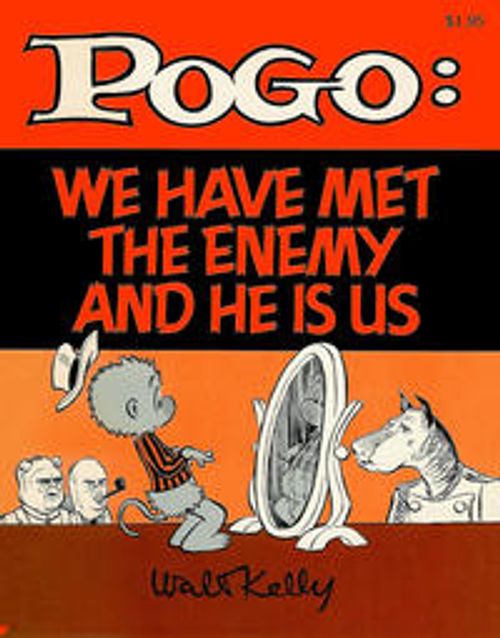
Walt Kelly, creator of the Pogo comics, said it best in 1970.
Rant over.
https://www.americanthinker.com/articles/2025/12/the_politics_of_cause_and_effect.html
The short article linked above explains one of the many problems we have with the current manifestation of our government; the delay in seeing the results of our decisions in the voting booth. One cause is the usually interminable slow process of our elected representatives enacting and implementing policy changes to effect necessary changes, whether at the local, state, or federal levels. Unless they have a personal agenda or are otherwise motivated. [*Wink wink*] Think of the Patriot Act or the TARP act.
While due diligence and thoughtful deliberations are necessary to achieve needed changes, the dog and pony shows we see in our governing bodies obscure our ability to connect cause and effect. It seemingly starts with tight-lipped politicians who refuse to be open and transparent about their thought processes, rightfully fearful they will reveal their lack of depth and clarity, thus exposing their inability or unwillingness to think long-term and big picture for the common good. Or fearful they'll lose the support of special interest constituencies necessary to retain their incumbency. So they resort to orchestration of the publicly seen process, a liturgy to sustain an illusion of openness and transparency and public duty.
Then come the drawn out bureaucratic processes of study groups, hearings soliciting stakeholder and public comments, trial balloons of flawed proposals subsequently returned or redirected to staff or committee or board or commission for further review or refinement. All of this occurs within the supposition (or desperately held hope) there's an ethos and culture within the hired government bureaucracy of ethical conduct, competence, and stewardship. Which given the odds, are likely isolated to only a few departments within the bureaucracy.
Earlier I stated, "It seemingly starts with tight-lipped politicians..." It would be more accurate to say it starts with the electorate, most of whom pay scant attention to the issues, who themselves are trapped in a short attention span prison, consumed with their pressing personal needs, despair, and distractions; unwilling to think critically, and more committed to relationships than principles. And then there are those who would naturally, instinctively, and cynically take advantage of their failure (refusal?) to think long-term and big picture. Those would be the so-called political class; the thought leaders, the deal makers, those lobbying and jockeying for advantage, the king makers, those pandering to increasingly narrow special interests.
I believe bell curve distribution of attributes are usually accurate. Bell curves don't have to be symmetrical and pretty, but they're usually workable depictions. And societal structures are historically pyramids.
Walt Kelly, creator of the Pogo comics, said it best in 1970.
Rant over.
**The Politics Of Cause And Effect**
https://www.americanthinker.com/articles/2025/12/the_politics_of_cause_and_effect.html
The short article linked above explains one of the many problems we have with the current manifestation of our government; the delay in seeing the results of our decisions in the voting booth. One cause is the usually interminable slow process of our elected representatives enacting and implementing policy changes to effect necessary changes, whether at the local, state, or federal levels. Unless they have a personal agenda or are otherwise motivated. [*Wink wink*] Think of the Patriot Act or the TARP act.
While due diligence and thoughtful deliberations are necessary to achieve needed changes, the dog and pony shows we see in our governing bodies obscure our ability to connect cause and effect. It seemingly starts with tight-lipped politicians who refuse to be open and transparent about their thought processes, rightfully fearful they will reveal their lack of depth and clarity, thus exposing their inability or unwillingness to think long-term and big picture for the common good. Or fearful they'll lose the support of special interest constituencies necessary to retain their incumbency. So they resort to orchestration of the publicly seen process, a liturgy to sustain an illusion of openness and transparency and public duty.
Then come the drawn out bureaucratic processes of study groups, hearings soliciting stakeholder and public comments, trial balloons of flawed proposals subsequently returned or redirected to staff or committee or board or commission for further review or refinement. All of this occurs within the supposition (or desperately held hope) there's an ethos and culture within the hired government bureaucracy of ethical conduct, competence, and stewardship. Which given the odds, are likely isolated to only a few departments within the bureaucracy.
Earlier I stated, "It seemingly starts with tight-lipped politicians..." It would be more accurate to say it starts with the electorate, most of whom pay scant attention to the issues, who themselves are trapped in a short attention span prison, consumed with their pressing personal needs, despair, and distractions; unwilling to think critically, and more committed to relationships than principles. And then there are those who would naturally, instinctively, and cynically take advantage of their failure (refusal?) to think long-term and big picture. Those would be the so-called political class; the thought leaders, the deal makers, those lobbying and jockeying for advantage, the king makers, those pandering to increasingly narrow special interests.
I believe bell curve distribution of attributes are usually accurate. Bell curves don't have to be symmetrical and pretty, but they're usually workable depictions. And societal structures are historically pyramids.
Walt Kelly, creator of the Pogo comics, said it best in 1970.
Rant over.
0 Commenti
0 condivisioni
5779 Views

 English
 Arabic
 French
 Spanish
 Portuguese
 Deutsch
 Turkish
 Dutch
Dutch
 Russian
 Romaian
 Portuguese (Brazil)
 Greek
Greek